The premise
Every firm I work with sells the same product.
Earned trust. Insurance, architecture, accounting, capital, law: different licenses, one product. Each firm was built on an engine that once did the earning automatically: a geography, a network, a track record, or a name that opened doors.
Those engines are stalling, and some firms never had one. The assignment is the same: attract the right prospects and earn their trust in an engagement landscape that has moved.
I build the complete marketing operation one firm at a time: the research, the positioning, the buyer psychology, the trust sequence, the assets, and the wiring. Then I train an AI marketing associate on every page of it and hand over the keys. The firm keeps the brain.
The shift
Your next client is searching right now. Only one of you knows it.
Prospects research before they call. Referral sources validate before they recommend. AI tools shape which firms seem relevant, credible, and specific enough to consider. Today’s buyer decides in private, before you hear a word.
AI collapsed the quality floor under everyone. When every firm can sound expert on demand, polish separates no one. The durable advantage is earned trust, shown in the right sequence.
Winning now means identifying, attracting, and engaging clients you do not know are looking, so trust is underway before the first meeting.
The foundations
The process stands on four connected foundations.
1. An engagement philosophyHow trust is earned, what a stranger must come to believe, and in what sequence.
2. Decision-aligned strategyMarketing strategy and tactics aligned with how audiences make decisions.
3. A modern technology ecosystemDesigned to identify and engage clients where they are, while keeping the firm legible to the machines those clients ask.
4. Managed infrastructureBuilt to be refined and managed for the long term, so the system compounds while leadership stays focused on the firm’s work.
The process
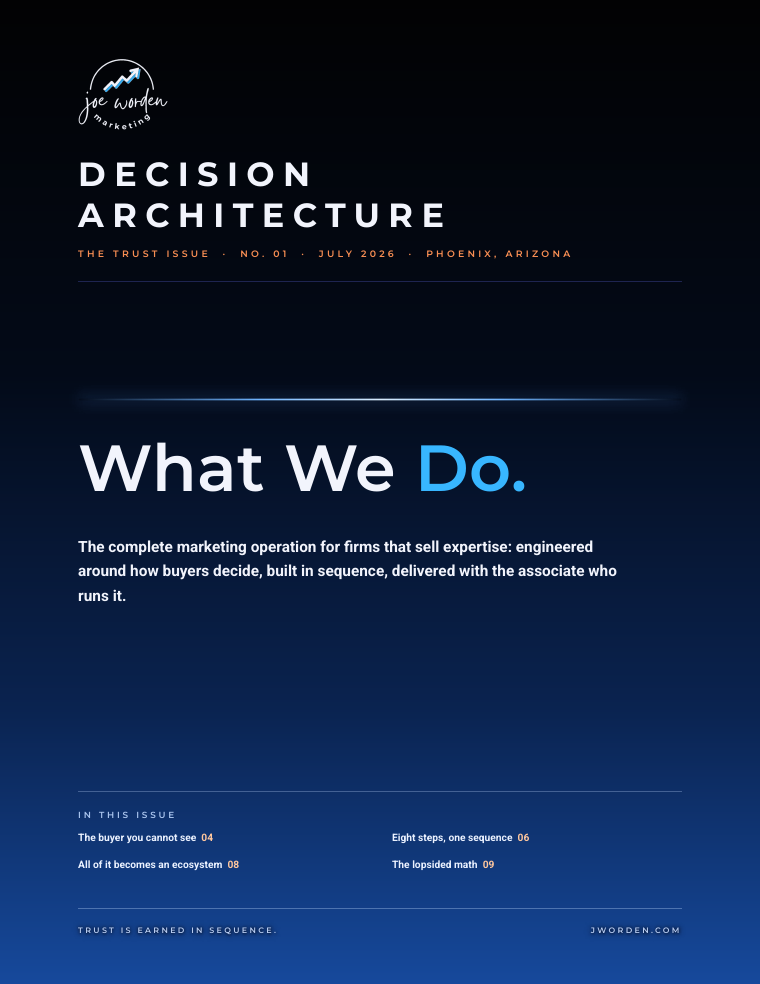
Eight steps, one sequence.
Trust is earned in sequence, aligned with how decision makers sort through complex options. Each step produces something the firm keeps, and each feeds the next.
- Research and DiscoveryYour industry, competitive field, and how buyers decide. What they fear, what has failed them, and what proof moves them.
- Brand and Market PositioningThe role the firm plays, its story, and a language system that keeps the positioning from drifting.
- Audience Segments and PersonasSegments in the sequence they can be won, with what moves each audience and what can stop the decision.
- Journey MappingEvery buyer climbs five gates: relevance, credibility, proof, safety, and action. The map assigns the right proof to each gate.
- Content and Naming ArchitectureEvery asset receives a name, a title, and a job. The result is a library, not a pile.
- Marketing Asset CreationWeb and landing pages, buyer education, email systems, thought leadership, sales enablement, and campaign packages.
- Ecosystem and Technology WiringChannels, plays, and assets are connected so outreach, follow-up, referrals, and measurement run in one place.
- Agent-Driven ExecutionThe full body of work grounds a marketing associate dedicated to the firm, and it runs the system every day.
The deliverables
What lands in your hands.
Every step leaves something behind that the firm owns. By the end, the shelf holds three layers.
01. The FoundationThe research, positioning, audience playbook, journey map, ecosystem, content architecture, and brand manual. Each document becomes structured guidance the system can execute against.
02. The Working SystemThe named asset library, a private microsite portal, and the wiring that makes outreach, follow-up, referrals, and measurement run as one system.
03. The ColleagueA dedicated marketing associate, grounded in the entire body of work and working inside the ecosystem.
The working ecosystem
The documents are the blueprint. The deliverable is the system they describe.
When the wiring is complete, the research, positioning, journeys, assets, and technology run as one connected ecosystem. Outreach, follow-up, referrals, and measurement move together, each informed by everything the engagement learned.
Inside that ecosystem works a dedicated marketing associate, grounded in the full body of work and working for the firm alone. It drafts, you send. It proposes, you approve. When it is unsure, it stops and asks. The judgment stays with you.
The economics
Two doors into the same build.
If a firm already invests in marketing, the system supplies the research, positioning, sequence, and operating intelligence that helps the existing team work from one architecture.
If a firm has no marketing operation, the same system gives a small firm the ability to compete on a broader stage without hiring an entire department.
The outcome
What changes when it runs.
Legible to peopleA stranger understands what the firm does, who it serves, and why it belongs in the decision.
Legible to machinesThe models buyers ask can summarize the firm without losing its meaning.
Trust on scheduleThe right people receive the right information through relevance, credibility, proof, safety, and action.
Marketing as operationsScattered activity becomes a repeatable system that runs while leadership stays focused on the work.
Why it has a name
The method is Decision Sequenced Marketing.
The philosophy behind it is Decision Architecture: consequential decisions form in a sequence, and the sequence can be designed. The method turns that philosophy into research, positioning, buyer journeys, assets, wiring, and an associate that helps run the system.
That is what I do.